 HR
HR IT
IT SL
SL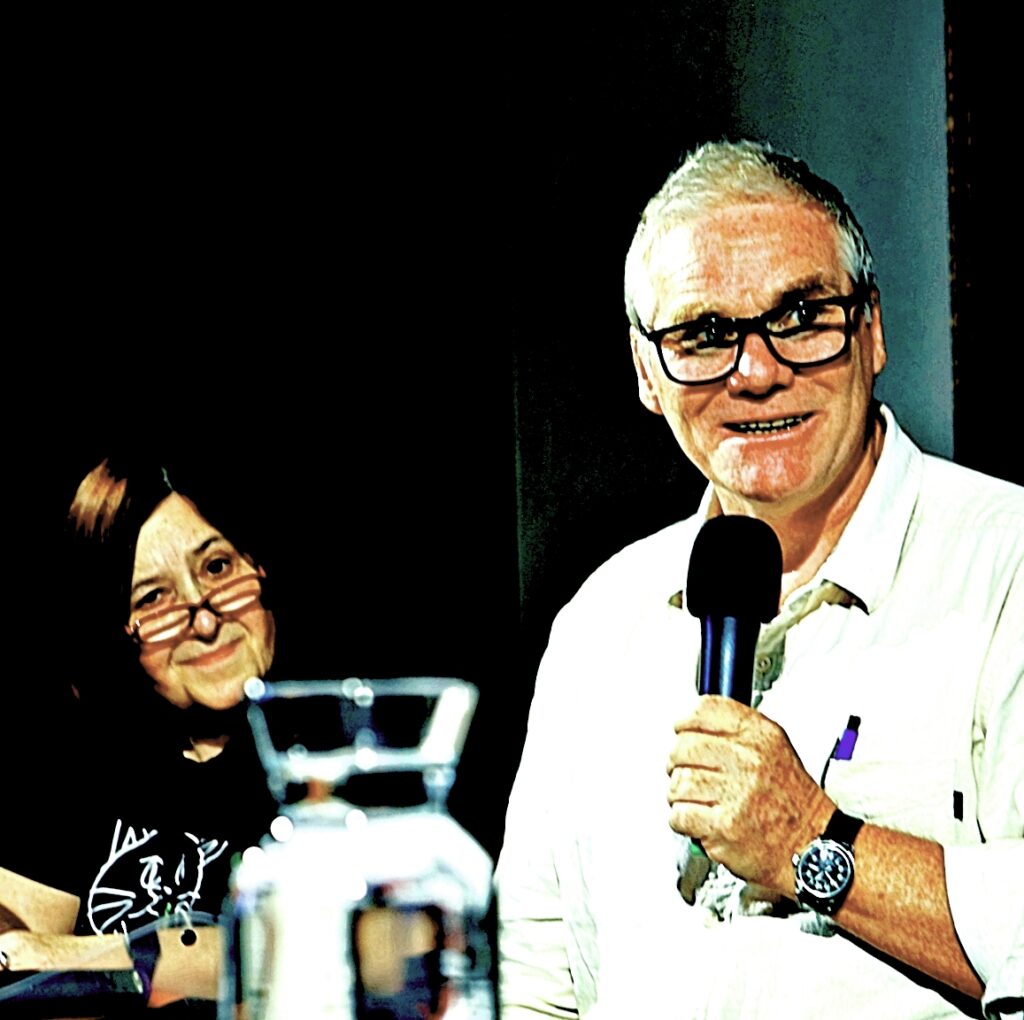
FORUM TOMIZZA 2025
SIMPOZIJ POHVALA LUDOSTI
PRETORSKA PALAČA, KOPAR
Chris Baldwin
“The Audience in the Era of Post Shame”
Don’t mention the children.
Don’t name the dead children.
The people must not know the names
of the dead children.
The names of the children must be hidden.
The children must be nameless.
The children must leave this world
having no names.
No one must know the names of
the dead children.
No one must say the names of
the dead children.
No one must even think that the children
have names.
People must understand that it would be dangerous
to know the names of the children.
The people must be protected from
knowing the names of the children.
The names of the children could spread
like wildfire.
The people would not be safe if they knew
the names of the children.
Don’t name the dead children.
Don’t remember the dead children.
Don’t think of the dead children.
Don’t say: ‘dead children’.”
(Don’t Mention the Children – By Michael Rosen)
I was struck by two lines in particular in this year’s introductory text for the Forum Tomizza 2025:
We recognize the madness of overestimating one’s own power.
and
Postmodern thought…brings the language of madness closer to the language of literature: the otherness of madness is a means of resistance that artists rely on in opposing contemporary forms of repression.
Well, as a theatre director I had a kind of intellectual and emotional rejection of the thought that it was post-modernism which brings madness closer to literature. And this is what I will try to address today in the following fifteen minutes.
In medieval English theatre there is a figure (a early character type) called the vice. It is a representative of the devil and appears in many plays including the English mysteries. These vices and devils are given the task of trying to lure man away from conversion and from God’s path. And all these vice figures have certain traits in common. They,
· are linguistically dexterous, brilliant and articulate with words,
· employ parody, sarcasm and irony to belittle,
· use anti-religious jabs. These are their stock-in-trade.
· always display some form of physical deformity.
The figure of the vice is also a social satirist hinting at political motives for priestly conduct.
In other words, through the character of the vice, the spirit of carnival, leapt into theatre.
The vice figure as a character in a play possesses that central quality unattainable in carnival: plays explore relationships between individuals and roles – while rituals (like carnival) only deal with roles.
So in theatre, the vice becomes dynamic, able to take us, the audience, on a journey. And the key element in this is always our willingness or not to go on that journey, to be seduced…or not.
The vice is the antecedent to the clown, an improvising marauder whose impulse is to create mayhem.
As important as this is, it means little unless we recognise that the power of the vice/clown lineage is in the fact that he stands much closer to the audience than to the play.
Shakespeare’s working life straddled two epochs. The very late medieval theatre had declined by the time he was producing plays, and public playhouses had been established. Gradually the theatrical conventions of medieval theatre got abandoned too. But one key element never completely died. He incorporated the vice figure into his plays, and very clearly so into his early plays.
I want to talk briefly talk about the play Richard III from 1592 – written some 50 years after the death of Erasmus – a play in which Richard of Gloucester becomes king through a series of grotesque acts of violence.
Who else, apart fro Richard himself, can be considered involved in his upward trajectory? What happens when Richard of Gloucester moves across the stage and declares himself a shape-shifting vice? We will try to answer this in a moment. But first let me suggest the writing of this play marks a critical moment in the history of the English playhouse because the anti-character has taken centre stage. Shakespeare uses the ancient figure of the vice as a voice that counters dominant ideologies. The vice figure allows “the outside” voice onto the stage.
But when we come to consider Richard III something much more radical has also occurred. The vice is seen directing the main plot. The counter ideology is seen to roam about the stage. Richard of Gloucester sets about his criminal rise to power while maintaining, like the traditional vice, and this is the important point, continuous contact with the audience. In fact, that is where the politics are located. It is the audience that enables the rise of Richard of Gloucester to the throne. How?
In the very first action of the play Richard has a soliloquy. Now its really very important to examine a massive mistake that occurred in the 19th century and into the 20th century in acting techniques in regard to Shakespeare.
With the rise of the “fourth wall” (that invisible wall between performer and audience), the inner world of the characters and the play, became dominant. Ibsen, Chekhov, Stanislavsky all contribute towards an ever-increasing separation between the world of the play and the world of the audience. In this kind of theatre the audience was invited to watch, observe, remain silent – and in the dark. They were to express their evaluation of the work of the actors (not the characters) after the lights came up – only technically possible as a result of the introduction of electric lighting into the theatre.
But the concept of the fourth wall was used to influence not just the way to direct naturalistic plays, such as those written by Ibsen, but for all plays – even those non naturalistic plays such as those by Shakespeare. As a result, the politics of Shakespeare in at least one utterly fundamental way, got lost for decades. His vice characters had been designed to speak directly to the audience. That was the medieval legacy. Soliloquies were not internal musings or meditations but rather direct addresses, invitations for complicity between the vice and a proactive, moral, immoral, amoral, seducible or repulse-ible audience. This may have changed somewhat by Hamlet – but it is most definitely the case with the earlier Richard III.
By Shakespeare’s time the theatre has achieved a potential to act as a politically and socially destabilising force. And as the most social of all art forms, theatre would thus require strict regulating by state and church alike. And it got exactly that. One innovation over the centuries after Shakespeare was the arrival of the theatre director, someone like me, to control the events and guard the interests of the powerful.
But let’s just take a look briefly at the opening speech of the play Richard III. Richard, alone onstage, reveals his intention to play the villain. He then pretends to console Clarence, the first victim of this villainy. The question we must answer is the following: WHO thus knows everything in advance? Who is told by Richard of his plan? Who can assess his worth or danger within just a few seconds of the start of the play? The answer is clear. You and I. The audience. Listen to how he tells us exactly what he plans to do:
GLOUCESTER:
I am determined to prove a villain
And hate the idle pleasures of these days.
Plots have I laid, inductions dangerous,
By drunken prophecies, libels and dreams,
To set my brother Clarence and the king
In deadly hate the one against the other:
When a 19th or even 20th century theatre director approached that scene they would more than likely approach it as an internalised musing. The actor would take to the stage talking aloud of course, but to himself, with an audience effectively only overhearing it, so to say .
But as a result of a series of rethinks in the 20th century, as much archaeological as political, it was discovered or re-discovered that these musings, monologues, were actually direct addresses to the audience. And this could not be ignored.
How did we rediscover this? Well today is not the time to address this in much detail – except to say:
· archaeologists discovered the shape of the Globe theatre stage and the fact there were no side-wings (the actor had nowhere to hide),
· plays were performed in daytime as they needed the natural light – provided by the roof-less theatre- so the audience was never invisible to actors or to one another, and the audience observed the play from 3 sides.
· The architecture of the space thus facilitated, forced even, “acknowledgement” of the actor playing a character by the spectator.
And the second reason is because we know where Richard III came from. He is a direct descendant of the vice figure and medieval morality plays – someone who came from street carnival and derived their power from a tricky, never broken, connivance with the audience. He was never your friend. But he did take you into his confidence – just like any trickster does today. I invite you to think of Trump.
And here is the key point. Once Richard of Gloucester grabs power, after he murders everyone in his path to power, having shared those plans and ambitions with you, me and all in the audience before he enacts them, we ALL become co-criminals. When Richard no longer needs our silent, delicious acquiescence, or our complicity, guess what happens? Yes, the direct addresses to us stop. He stops addressing or acknowledging us. We become dispensable. We are his next victims.
And perhaps this is the learning the play offers us. If we take pleasure in the act of observing, from the position of privilege, the rise of a monster, if our silence makes us complicit, it will be short-lived. But the politics of that idea, as it is so embedded in dramaturgy and staging, is utterly absent if the play is treated to the ever-present danger of naturalistic staging appropriate to Ibsen or Chekhov.
On the 26th of February 2025 an AI generated video smashed into our brains and settled in our memory-systems rather like a bomb wedging into a concrete apartment block. Lasting only 32 seconds, the video was shared by US President Trump himself on his own social media platform, Truth Social, and Instagram.
Like billions of others across the planet I saw the video within an hour of its ‘dropping’. I guess that many of you saw it too. If you did not see it I won’t describe it frame by frame. Its out there, on Youtube.
It portrays a post-genocidal Gaza – with Trump, Netanyahu and Musk the obvious victors, sipping Pina Coladas in reclining sun lounges in some kind of Las Vagas cum Rafah. It took a few days to discover which artists had produced this video using AI. But I followed their story closely and wrote about it in some detail in a publication at for Clickbait Citizen.
As I watched that video a thought entered my head. The vice is here. He never went away. He moved from carnival to the theatre and then into performative politics and now to the pinnacle of global power.
And let’s be unambiguous. Trump and his Republican Party are a huge danger to the planet – to everything we should be holding close. Our families. Our values, our climate, our future. Our democracies. But it is sickening to hear liberals call him a buffoon. His political strategy is flawless. And he learned it from understanding politics – but also the entertainment industry. Believe me, I recognise his talents and his techniques. For I too come from that same industry.
It is our complicity as audiences, as citizens, in the process of propelling these bewitching monsters to power, which is the element that has remained stable throughout the centuries. And that is what Shakespeare is interested in exploring and bringing to our attention in his play Richard III.
It is undeniable that billions of people watched that AI post-genocide video and were told what was coming for Gaza. It is all there. Shakespeare warned us, through his use of the vice-figure, of the way we, the public, could enjoy being seduced and become complicit in heinous crimes. Bourgeois naturalism tried to castrate and hide Shakespeare’s political staging and radicalness. And in that way it contributed in some way to the catastrophe of fascism in the Europe of the 1930’s.
But now?
—————-
But is it just too late now?
Are we to live the consequences again? In a post-shame era?
Have we all agreed simply not to mention the children?
—————-
And many too agreed not to mention the children.
Not to name the dead children.
We agreed not to mention the names of dead children.
Chris Baldwin